header

WERA NorthernRadar

WERA
WERA

WERA NorthernRadar

For additional information on WERA please click on the following
link to Helzel’s website

WERA NorthernRadar is an Oceanographic HF Radar providing simultaneous measurement of:

  • Surface currents maps
  • Ocean waves parameters and maps
  • Wind direction (wind speed under development)

These measured data are available

  • Over long distances (more than 200 km) and large areas with good temporal resolution (complete data set within less than 10 minutes)
  • with high spatial resolution (down to 250 m)

Feature list (click here)

Principals of Operation

The WERA system (WavE RAdar) is a shore based remote sensing system using the over the horizon radar technology to monitor ocean surface currents, waves and wind direction (Gurgel, 1999). This long range, high resolution monitoring system operates with radio frequencies between 4 and 50 MHz. A vertical polarized electromagnetic wave is coupled to the conductive ocean surface and follows the curvature of the earth.

The rough ocean surface interacts with the radio wave and due to the Bragg effect back-scattered signals can be detected from ranges of more than 200 km. This effect was first described in 1955 by Crombie (Crombie, 1955) and the first radar system using that effect was developed by Barrick et al (Barrick, 1977) at NOAA in 1977.

The Bragg effect describes the coupling of the electromagnetic
wave with the ocean wave field. To fulfil the Bragg conditions the electromagnetic wave length needs to have twice the wavelength as the ocean wave, e.g. for a 30 MHz radar signal with Lambda 10 m, the corresponding ocean wave is 5 m. Reflections from waves that fulfil this condition will generate
a dominant signature in the received signal spectrum due to in-phase summation of amplitudes.

Applications

WERA NorthernRadar provide a lot of useful data for various applications. Typical users are:

  • meteorological institutes
  • coastal management (erosion, flooding, pollution, etc.)
  • port authorities & harbour management
  • environmental monitoring & research
  • oil & gas industries
  • oceanographic researchers
  • vessel traffic services (ship tracking is under development)
  • renewable energy providers (wind farm planning and management)
  • component for tsunami warning systems

Recent collaboration of Northern Radar Inc. of St. John’s NL and ASL Environmental Sciences Inc. of Victoria BC and Helzel Messtechnik GmbH of Germany has led to the development of the “WERA NorthernRadar” system – an updated and enhanced version of the “Helzel WERA” HF radar system. 
Click here for more information on the collaboration.

Partial list of references

Coastal Radar "WERA", a tool for Harbour Management (pdf 761 KB) Thomas Helzel, Vincent Mariette, Marc Pavec, 2010

HF Radar WERA Application for Ship Detection and Tracking (pdf 1,2 MB)
Anna Dzvonkovskaya, Klaus-Werner Gurgel, Hermann Rohling, Thomas Schlick, 2009

Future Contribution of HF Radar WERA to Tsunami Early Warning Systems (pdf 1,3 MB) Anna Dzvonkovskaya, Klaus-Werner Gurgel, 2009

WERA Basics - Remote Ocean Sensing for Currents, Waves and Wind (pdf 837 KB)
T. Helzel, M. Kniephoff, L. Petersen, 2006


WERA-map

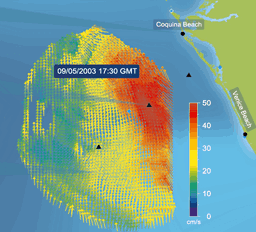
The robust shore based system delivers reliable data even under extreme weather and dynamic ocean current conditions. This surface current image was taken during the passage of tropical storm Henri on the 5th of September 2003
(Nick Shay, Rosenstiel School of Marine and Atmospheric Science (RSMAS), Miami).
(Click on image to enlarge)


WERA-pic2

Maps of Significant Wave Height are available for each grid point within half of the radar range. This wave map was taken at the east coast of South Carolina and Georgia (Dana Savidge, Skidaway Institute of Oceanography and Rich Styles, USC)
(Click on image to enlarge)


Surface current map at German Bight located in the southeastern North Sea bounded by the Netherlands and Germany to the south, and Denmark and Germany to the east (GKSS Research Center, Geestacht and University of Hamburg).
(Click to enlarge image)


Listed below are two examples of how the WERA HF Radar system is being used: